0

Nidhi Software for Nidhi Company in India

Nidhi Software for Nidhi Company in India 1

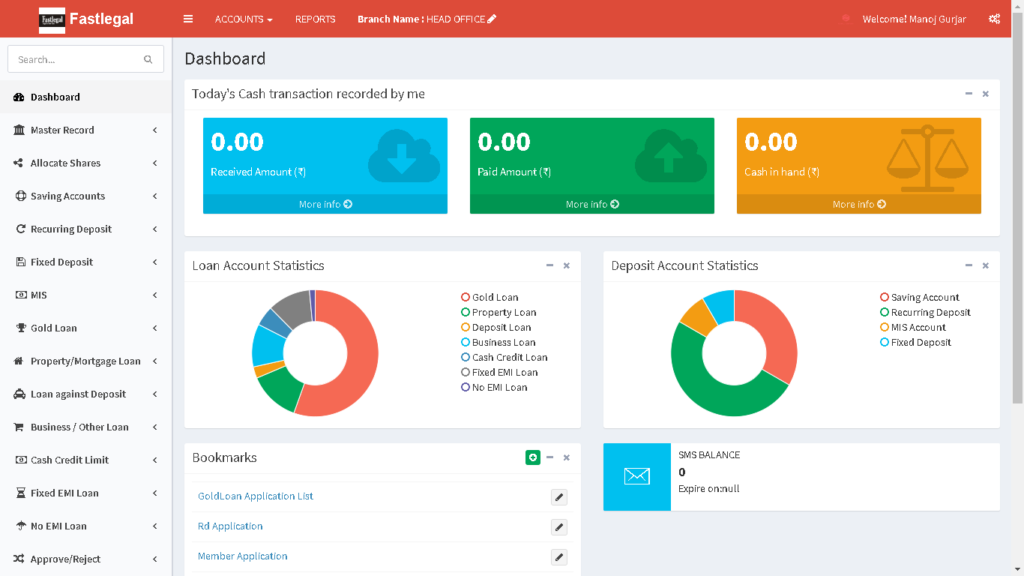
NidhiExpert”-A web-based Nidhi Software in India for managing financial and compliance-related affairs of Nidhi Companies. “NidhiExpert” was launched around 2 years ago and more than 400+Nidhi Companies are using this software for managing their Nidhi Companies satisfactorily. Some important features of the software are listed below:-

Why “Nidhiexpert” is Best Nidhi Software in India

Cloud Ready

Get set ready Go! Start on-boarding new customers in 12hrs.

Secure loan & deposit management Software to keep your data Safe.Your data is Secure

No Need of Pre-printed Stationary

Membership Form, Loan and Deposit Application Form, FD/RD Bond, Loan and Deposit Account Statements.

Store Documents & Cases

Store as many Documents and case details as you want.

Accounting, Tax, P&L and Auditing friendly

Manage & Customize all your Accounting operations on the same Software.

Mobile Ready Solutions

Easily access and manage all your data from the Mobile.

Other Features of NidhiExpert – Nidhi Software

  • Opening of Branch wise Deposit & Loan Accounts.
  • Branch-Wise Report of Loan and Deposit Accounts.
  • Date Wise Collection Report of Branches.
  • Date Wise Disbursement Report of Branches.
  • Create an Unlimited User.
  • Manage User Rights.
  • Activation/De-activation of User Account.
  • Set Timings for Users to access the Software
  • Gold/Jewellery Loan
  • Loan Against Deposit
  • Property/Mortgage Loan
  • Fixed EMI Loan
  • Cash Credit Limit


Manage Multiple Deposit TypesPrint System Generated Forms, Receipts and Agreements

Statutory Compliance as per Companies Act & Nidhi Rules,2014 


  • Saving Account
  • Fixed Deposit Account
  • RD Account
  • MIS Account


nidhi software


  • Deposit Account Application Form(Saving,RD,FD & MIS)
  • Loan Account Application Form (For All Loan Types)
  • Membership Application Form
  • Cash/Bank Receipts
  • Share Certificates and Share Transfer Form
  • Loan Agreement


  • Auto Generated Share Folio Number
  • List of Shareholders
  • Details of Share Transfer
  • Form NDH-3 & NDH-1
  • Calculate amount of unencumbered deposit
  • Statutory Compliance Calendar

Customer Login and Fund Transfer

SMS to Account Holders


System Generated Ledgers and Voucher Entry 


  • Create Customer Login ID & Password
  • Customer can login and check their statements & dues
  • Intra-Nidhi Fund Transfer
  • OTP based authentication for Transfer of Funds


  • Auto SMS on Account Opening, Deposit and Withdrawal of Amount with updated balance
  • Fully Customize the message content
  • Manage member wise message sending


  • System generated vouchers for financial transactions
  • Auto voucher entry for financial transactions
  • Trial Balance
  • Profit and Loss Account
  • Balance Sheet

Ledger Creation and Voucher Entry

  • Ledger Groups
  • Create Ledgers
  • Post Voucher entry
  • Complete Accounting Solution


 Request a Demo-Whatsapp or Call At +91-96641-46595

0

FDI in Cash & Carry Wholesale Trading/Wholesale Trading in India

FDI in Wholesale Trading is allowed 100% under Automatic Route Subject to some Conditions. 

Meaning of Wholesale Trading/ Cash and Carry Wholesale Trading 

Cash & Carry Wholesale trading/Wholesale trading, would mean sale of goods/merchandise to retailers, industrial, commercial, institutional or other professional business users or to other wholesalers and related subordinated service providers. Wholesale trading would, accordingly, imply sales for the purpose of trade, business and profession, as opposed to sales for the purpose of personal consumption. The yardstick to determine whether the sale is wholesale or not would be the type of customers to whom the sale is made and not the size and volume of sales. Wholesale trading would include resale, processing and thereafter sale, bulk imports with ex-port/ex-bonded warehouse business sales and B2B e-Commerce

2. Guidelines for Cash & Carry Wholesale Trading/Wholesale Trading (WT)

(a) For undertaking WT, requisite licenses/registration/ permits, as specified under the relevant Acts/Regulations/Rules/Orders of the State Government/Government Body/Government Authority/Local Self-Government Body under that State Government should be obtained.

(b) Except in case of sales to Government, sales made by the wholesaler would be considered as ‘cash & carry wholesale trading/wholesale trading’ with valid business customers, only when WT are made to the following entities:

(I) Entities holding sales tax/ VAT registration/service tax/excise duty registration; or

(II) Entities holding trade licenses i.e. a license/registration certificate/membership certificate/registration under Shops and Establishment Act, issued by a Government Authority/Government Body/Local Self-Government Authority, reflecting that the entity/person holding the license/ registration certificate/ membership certificate, as the case may be, is itself/ himself/herself engaged in a business involving commercial activity; or

(III) Entities holding permits/license etc. for undertaking retail trade (like tehbazari and similar license for hawkers) from Government Authorities/Local Self Government Bodies; or

(IV) Institutions having certificate of incorporation or registration as a society or registration as public trust for their self consumption.

Note: An entity, to whom WT is made, may fulfill any one of the 4 conditions

(c) Full records indicating all the details of such sales like name of entity, kind of entity, registration/license/permit etc. number, amount of sale etc. should be maintained on a day to day basis.

(d) WT of goods would be permitted among companies of the same group. However, such WT to group companies taken together should not exceed 25% of the total turnover of the wholesale venture.

(e) WT can be undertaken as per normal business practice, including extending credit facilities subject to applicable regulations.

(f) A wholesale/cash & carry trader can undertake retail trading, subject to the conditions as applicable. An entity undertaking wholesale/cash and carry as well as retail business will be mandated to maintain separate books of accounts for these two arms of the business and duly audited by the statutory auditors. Conditions of the FDI policy for wholesale/cash and carry business and for retail business have to be separately complied with by the respective business arms.

1

List of Information and Documents required for Startup Registration

If you are planning to register your company as startup in India, you need to provide information and documents for your startup at statupindia.gov.in once you signup for registration. Startup recognisation provides benefits to entities, including benifits for IP registrations etc.

Documents required for Startup Registration

Following information and documents required for Startup India registration :

  1. Name of Company
  2. Name of Startup
  3. Website address of Company
  4. Name , age qualification of Directors and Promoter / Authorized Representative
  5. Current Number of Employees including Founders
  6. Trademark or other IP details
  7. Is the startup creating an innovative product / service / process or improving an existing product / service / process ?
  8. Is the startup creating a scalable business model with high potential of employment generation or wealth creation ?
  9. Brief note supporting the options chosen above for innovation, improvement and scalability
  10. Has your startup received any funding?
  11. Any awards/recognition received by the entity , if yes , provide document in support
  12. What is the problem the startup is solving ? 150 to 200 words  minimum
  13. How does your startup propose to solve this problem? 150 to 200 words minimum
  14. What is the uniqueness of your solution ? 150 to 200 words minimum
    15.How does your startup generate revenue? 150 to 200 words minimum
  15. App Link /Pitch Deck etc if any
  16. COI , MOA and AOA of Company
  17. PAN of Company

0

MSME Return to MCA/ROC

In the recent amendment the Ministry of Micro small and Medium enterprises prescribed Half Yearly Reporting to MCA by Companies 
which receives services or goods from micro or small enterprises and whose payments to micro and small enterprises suppliers exceed 45 days

Every company shall file in MSME Form I details of all outstanding dues to Micro or small enterprises suppliers existing on the date of notification of this order within thirty days from the date of publication of this notification – Means the Due date for First Return is 21st Feb, 2019

Everycompany shall file a return as per MSME Form I annexed to this Order, by 31st October for the period from April to September and by 30th April for the period from October to March.

Form Required to be Filed to MCA/ROC:-

MSME Form I

Information required to be Filed in MSME Form I:-

Initial return of outstanding dues to Micro or Small Enterprises Suppliers

Total outstanding amount due as on date of notification of this order

Particulars of the name of suppliers and amount of payments due :-

  • Financial Years/Particulars
  • Name of Suppliers
  • PAN of Suppliers
  • Amount Due
  • Specify the date from which amount is due

REGULAR RETURN OF OUTSTANDING DUES TO MICRO AND SMALL ENTERPIRSES

Total outstanding amount during April to September

Particulars of the name of suppliers and amount of payments due :-

  • Financial Years/Particulars
  • Name of Suppliers
  • PAN of Suppliers
  • Amount Due
  • Specify the date from which amount is due

Total outstanding amount during October to March

  • Financial Years/Particulars
  • Name of Suppliers
  • PAN of Suppliers
  • Amount Due
  • Specify the date from which amount is due

Reasons for Delay in amount of payments due

The Form is required to be Digitally Signed by Director/CEO/Manager/Company Secretary of the Company

0

Recovery of dues by MSME’s through MSME Samadhan Scheme

Any MSME unit which has supplied goods or render any services to any Company or any other person (buyer of goods or recipient of Services ) and the buyer or recipent is delaying in payment or not making due payment as agreed , can make an application for recovery of dues by MSME under MSME Samadhan Scheme.

Where any Micro or small enterprises supplies any goods or render any services to any buyer, the buyer shall make payment therefor on or before the date agreed upon between him and the supplier. Period of payment between the supplier and the buyer in writing shall not exceed forty five days upon from the day of acceptance

Where the buyer fails to make payment to supplier within forty five days the buyer shall be liable to pay the amount with interest thereon.

Recovery of dues by MSME
MSME

Who can apply under for Recovery of dues by MSME:

Any Micro or small enterprises having valid Udyog Aadhar/Udhyam Registration (UAM) can make Application for recorvery of dues from Debtors.

How much Amount MSME unit can claim Recovery of dues by MSME under MSME Samadhan Scheme :

The buyer is liable to pay bill amount and compound interest with the monthly rests to the supplier. Interest is calculated on the amount at the three times of the bank rate notified by RBI.

Filing of Application under MSME Samadhan Scheme

MSME units are required to file Application under Msme Samadhan Portal online with all the supporting documents including Invoices, purchase orders etc.

Examination of Application by MSME department

MSME department will examine application filed by MSME unit and if application is complete in all respact than department will issue directions to the buyer unit for payment of due amount along with interest as per the provisions under the MSMED Act 2006.

Appeal by Appellant :

If the Appellant (not being the supplier) wants to file an appeal, no application for setting aside any decree or award by the state council shall be entertained by any court unless the appellant (not being supplier) has deposited with it, the 75% of the award amount.

0

Step-by-Step Guide: Filing Form 3 LLP Agreement with ROC

Limited Liability Partnerships (LLPs) offer the benefits of limited liability to their partners and are required to comply with various regulatory filings. One such compliance is the filing of Form 3, which pertains to the LLP Agreement. Here’s your step-by-step guide to understanding and filing Form 3 LLP Agreement with the Registrar of Companies (ROC).

Understanding LLP Form 3

LLP Form 3 is a document that provides details about the LLP Agreement, which governs the mutual rights and duties of the partners and the rights and duties in relation to that LLP.

Components of an LLP Agreement Typically Include:

  • Name of LLP
  • Name of partners and designated partners
  • Form of contribution
  • Profit-sharing ratio
  • Rights & duties of partners
  • Rules for governing the LLP
  • Dispute resolution mechanism
  • Indemnity clause

Filing Form 3: LLP Agreement with ROC

Step 1: Draft the LLP Agreement

  • Consult a legal expert to draft the LLP Agreement to ensure it complies with the LLP Act, 2008.
  • The agreement should be printed on Stamp Paper of a requisite value, which varies from state to state.

Step 2: Obtain Digital Signatures

  • Every designated partner must have a Digital Signature Certificate (DSC) because the filing process is online.

Step 3: Log in to the MCA Portal

  • Access the Ministry of Corporate Affairs (MCA) portal: http://www.mca.gov.in.
  • If you’re a new user, you need to create an account. Existing users can log in using their credentials.

Step 4: Fill Out Form 3

  • Navigate to the ‘LLP Forms’ section under the ‘MCA Services’ tab.
  • Download Form 3 from the LLP Forms section.
  • Fill in the necessary details as per the LLP Agreement, such as
    • Date of Agreement
    • Details of LLP and obligation of partners

Step 5: Attach Required Documents

  • The LLP Agreement must be attached as a pdf document.
  • Ensure that you have all Annexures and schedules to the agreement ready to be attached.

Step 6: Verify and Digitally Sign the Form

  • The form must be digitally signed by a designated partner.
  • A practicing professional (Chartered Accountant, Company Secretary, Cost Accountant, or Lawyer) must certify the form.

Step 7: Pay the Filing Fees

  • Filing fees for Form 3 will depend on the total contribution of partners in the LLP.
  • You can find the applicable fee structure on the MCA portal.

Step 8: Submit Form 3

  • Once the payment is made, you can submit the Form 3 on the portal.
  • A Service Request Number (SRN) will be generated after submission, which can be used to track the form.

Step 9: Keep Track of the Filing Status

  • Check the status of your Form 3 filing using the SRN on the MCA portal.
  • It usually takes around 7-10 working days for the ROC to process and approve the Form 3.

Step 10: Receipt of Form 3 Registration

  • After approval, the ROC will register the LLP Agreement and a registration certificate for Form 3 will be issued.
  • The certificate is a conclusive proof of registration of the LLP Agreement.

After your Form 3 has been successfully filed and registered, ensure to comply with further statutory filings as required under the LLP Act, like the annual return in Form 11 and the Statement of Accounts in Form 8.

Always consult with a corporate lawyer for accurate and legal advice tailored to your specific circumstances. This general guide is informative but does not account for every possible scenario or change in law over time.

0

Top UPI payment apps in India

In this article we will discuss about the top UPI payment apps in India, up enables easier and faster transfer using mobile applications, UPI handle or username is required for receiving and sending funds in bank account.

Due of it’s easy to operate user interface, UPI system has grown significantly in last 2-3 years and many people and business started accepting payments via UPI. As the increasing uses of UPI the fintech applications that facilitates payments system via UPI has got major competation which has leads to better customer service and quick adoption of UPI payment system in India.

List of top UPI payment apps in India

Phonepe

Phonepe is an UPI payment app grown significantly is among the top UPI apps in India,

Top UPI payment apps in India 2

Google pay

Backed by Google , Google pay got significant presence in UPI payment services in India, Google pay is among the first choice of users.

Top UPI payment apps in India 3

Paytm UPI

Paytm is first and grown significantly and has major market share amoung the UPI payment services

Top UPI payment apps in India 4

Bhim App

Bhim is first UPI payment app and backed by National payment Corporation of India, the first UPI payment system app launched by PM Modi. Bhim has done lot of improvements in its UI and added other features to its portfolio and able to get good response from market even today where other market players are heavily spending lots of money on advertising.

Top UPI payment apps in India 5
0

Declaration of Commencement of Business by Company

Declaration of Commencement of Business by Company 6

The new Section 10A has been introduced through Companies Amendment Ordinance 2018 with effect from 2nd November , 2018 which provides that every company is now required to file e Form INC 20A with Registrar of Companies within 180 days of its Incorporation for commencement of its business.

Main Requirements for Filing Form INC 20A:

  • The Subscribers has paid the share subscription amount to the Company
  • That the Company has obtained the regulatory approval required to be obtained for commencement of business for business activities which are specially regulated by other sectoral regulators like SEBI, RBI, IRDA etc.. 

What is required to done now :

  • No waiting for Opening of Bank Account 
  • Deposit Share Subscription amount in Company Bank Account 
  • File Form INC-22 for verification of Registered office 
  • File Form INC-20A within ASAP, not later than 180 days of Incorporation of Company 

How to pay Share Subscription amount to Company :

As normal practice every company is registered with Rs. 1Lakh  paid up capital, now it is compulsory that Rs. 1Lakh should be compulsory deposited in Company Bank Account within 180 days of its registration, so it is advisable to avoid incorporating company with higher paid up amount and promoters should go with Rs. 1000/10000 like paid up amount that can easily be paid to company account and Authorized capital of the company should be made at higher limit , so to issue shares at the later stage if required capital is introduced afterwards. 

Lesser amount can also be paid to company by cash , so having lesser amount of paid up capital will help you to better comply with this section. It Is always advisable to deposit the subscription amount to company bank Account as soon as Bank Account of newly incorporated company is opened.  

Section 10A.Commencement of business etc.


(1) A company incorporated after the commencement of the Companies (Amendment) Ordinance, 2018 and having a share capital shall not commence any business or exercise any borrowing powers unless—
(a) a declaration is filed by a director within a period of one hundred and eighty days of the date of incorporation of the company in such form and verified in such manner as may be prescribed, with the Registrar that every subscriber to the memorandum has paid the value of the shares agreed to be taken by him on the date of making of such declaration; and 
(b) The company has filed with the Registrar a verification of its registered office as provided in sub-­section (2) of section 12.  

(2) If any default is made in complying with the requirements of this section, the company shall be liable to a penalty of fifty thousand rupees and every officer who is in default shall be liable to a penalty of one thousand rupees for each day during which such default continues but not exceeding an amount of one lakh rupees.

 (3) Where no declaration has been filed with the Registrar under clause (a) of sub-section (1) within a period of one hundred and eighty days of the date of incorporation of the company and the Registrar has reasonable cause to believe that the company is not carrying on any business or operations, he may, without prejudice to the provisions of sub-section (2), initiate action for the removal of the name of the company from the register of companies under Chapter XVIII.

How to Register Sole Proprietorship Firm Online in India

0

How to Change the Nominee or Member of One Person Company

Every One Person Company shall always have Nominee of Member, that who shall become the member of the company in the event of death or incapacity to contract of member of Once Person of the Company.

First Nominee is declared at the time of Incorporation of company  with consent of nominee form INC -3

Now in case Member of One Person of the company wanted to Change the Nominee of Member than he can do so by Filing prescribed form to Registrar of Companies in Form INC-4

Form INC-4 is required to Filed in Following Cases :

  1. Notice of withdrawal of consent by the nominee of OPC
  2. Intimation about change in the name of the nominee of OPC
  3. Intimation of Cessation

Notice of withdrawal of consent by the nominee of OPC: 

Form INC-4 is required to filed when the Nominee has withdrawal consent to act as nominee of OPC, than the member of the Company shall nominate any other person as Nominee of the Company by taking consent of nominee in form INC-3 along with ID and Address Proof of Nominee.

Intimation about change in the name of the nominee of OPC:

Form INC-4 is required to be when there is change in nominee due to Change in Nominee by Member of OPC

Intimation of Cessation:

When the Member of the Company ceased to be member of the Company due to

  • transfer of ownership of the company to other person ,
  • Death of the member
  • Incapacity of member to contract

In this case the transferee or the nominee will become the member of the company.

In case of Change in Member either member can choose to Change the Nominee to new person or the existing nominee can remain the nominee.