Input Service Distributor (ISD) under GST – Registration, Requirements & Compliance

Running a business often means you have multiple branches, offices, or units across India. Some services—like audit fees, advertising, software subscriptions, or consultancy—are used centrally but benefit all your branches.

So, here’s the question: How do you fairly distribute the tax credit (ITC) from these services to each branch?

The answer under GST is through an Input Service Distributor (ISD).

Let’s break it down in simple terms.

🌱 What is an Input Service Distributor (ISD)?

An ISD is basically an office of a company that receives invoices for input services and then distributes the Input Tax Credit (ITC) to its other branches/units.

👉 Example:

Your head office in Jaipur pays for advertising services worth ₹10,00,000 plus GST. This advertising benefits your Delhi, Mumbai, and Bangalore branches too. Instead of keeping all the ITC at Jaipur, the head office (as ISD) distributes the ITC to the respective branches proportionately.

📝 When Do You Need ISD Registration?

You must register as an ISD if:

You have a head office or central office receiving invoices for services that are used by multiple branches. You want to distribute ITC to branches/units registered under the same PAN.

⚠️ Important:

ISD registration is separate from your normal GST registration. Even if you already have GST registration as a supplier, you need a distinct registration for ISD.

📌 Registration Requirements

Apply online through GST REG-01 form on GST portal. Choose “Input Service Distributor” as your type of registration. Documents needed are similar to GST registration (PAN, proof of business, address, authorization letter, etc.). Separate GSTIN will be issued for ISD.

📊 How Does Credit Distribution Work?

Eligible ITC only can be distributed. Credit is distributed on a pro-rata basis (turnover ratio) to branches that actually use the services. The distribution is done using ISD invoices.

👉 Example:

Head office gets consultancy bill with GST of ₹90,000. Branch A turnover = ₹2 Cr, Branch B turnover = ₹1 Cr (total = ₹3 Cr). Distribution: Branch A gets ITC of ₹60,000 (2/3rd), Branch B gets ₹30,000 (1/3rd).

✅ Compliance for ISD

Issue ISD Invoices – For credit distribution to branches. File Monthly Returns (GSTR-6) – Mandatory, due by the 13th of every month. Reconcile ITC – Ensure ITC distributed matches invoices uploaded by suppliers. Maintain Proper Records – Keep track of invoices received and ITC distributed.

⚖️ Key Points to Remember

ISD mechanism is only for input services, not goods. ITC must be distributed only to GST-registered branches under the same PAN. If service is used exclusively by one branch, ITC should go only to that branch. Distribution must be through GST portal and proper ISD invoices.

💡 Why ISD Matters

Avoids tax credit blockage at head office. Ensures fair distribution of credit to revenue-generating branches. Helps in smooth GST compliance and avoids disputes during audit.

✨ Final Thought

If your business has multiple branches and you’re receiving centralised service invoices, ISD registration is not just an option—it’s a must. It ensures every branch gets its rightful share of ITC, helping you optimise cash flow and stay GST-compliant.

Many startups and growing businesses overlook ISD until audits raise questions. Getting registered early and maintaining compliance can save you from unnecessary headaches later.
1

HSN Code In GSTR-1 Return

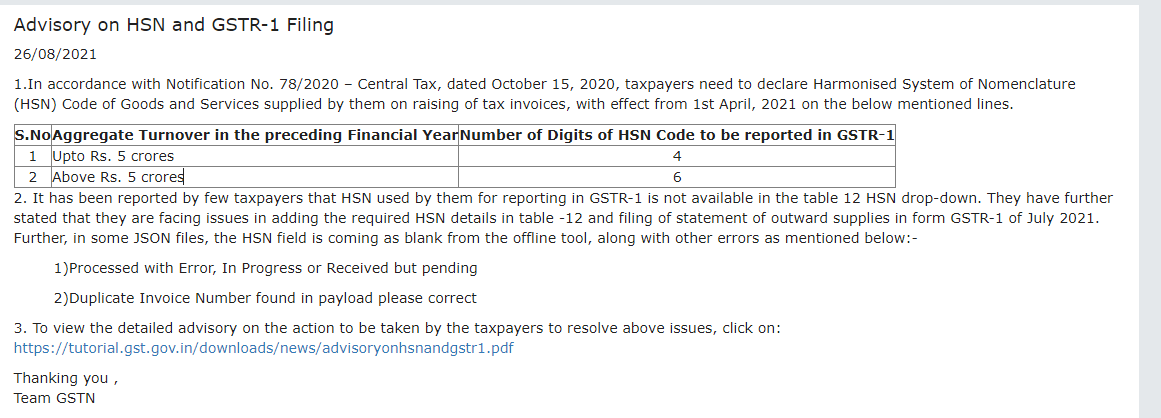
In accordance with Notification No. 78/2020 – Central Tax, dated October 15, 2020, taxpayers need to declare Harmonised System of Nomenclature (HSN) Code of Goods and Services supplied by them on raising of tax invoices, with effect from 1st April, 2021 on the below mentioned lines in GSTR-1 return (HSN Code In GSTR-1 Return)

S.NoAggregate Turnover in the preceding Financial YearNumber of Digits of HSN Code to be reported in GSTR-1
1Upto Rs. 5 crores4
2Above Rs. 5 crores6
HSN Code In GSTR-1 Return

3. To view the detailed advisory on the action to be taken by the taxpayers to resolve above issues, click on: https://tutorial.gst.gov.in/downloads/news/advisoryonhsnandgstr1.pdf

0

How to File Appeal Against Rejection of GST Registration

In this article, we will discuss the main requirement for filing for appeal against the Rejection of GST Registration, GST Amendment, Cancellation of Registration, etc., Any GST taxpayer may file an appeal if he is not satisfied with the order passed by the designated officer. Appeal for an order against registration application is required to be filed in Form GST APL-01

Appeal Against Rejection of GST Registration

Which type of Registration Rejection orders for which appeal can be filed

  • Order of Rejection of Application for Registration for all Taxpayers
  • Order of Rejection of Application for Amendment for all Taxpayers
  • Order of Rejection of Application for Cancellation for all Taxpayers
  • Order of Rejection of Application for Revocation of Cancellation
  • Order for rejection of reply to show cause notice issued in Form GST CMP-05
  • Order for Cancellation of Registration
  • Order of Cancellation of Registration as Tax Deductor at source or Tax Collector at source
  • Order for cancellation of provisional registration
  • Order of rejection of enrolment as GST Practitioner

Form in which appeal is required to be filed for GST Registration Rejection

Form GST APL -01 is required to be filed online and The appellant is required to submit a physical copy of supporting documents along with the appeal application, duly signed and verified to the office of the appellate authority within 7 days of filing an appeal on the GST Portal. Upon receipt of complete documents, the final acknowledgment will be issued to him.

Time Period in which Appeal Against Rejection of GST Registration Can be filed with Appealte Authority

Any taxpayer or an unregistered person aggrieved by any decision or order passed against him (with respect to Registration, amendment or cancellation etc.) by an adjudicating authority, may appeal to the Appellate Authority, within three months from the date on which the said decision or order is communicated to such person.

The appellate authority may condone delay for a period of a maximum of 1 month if he is satisfied that the taxpayer was prevented by sufficient cause from presenting the appeal within the aforesaid period of three months and allow it to be presented within a further period of one month.

0

GST Return Late Fee Amnesty Scheme

Amnesty Scheme to provide relief to taxpayers regarding late fee for
pending returns:

Reduced GST Late fee for earlier periods


To provide relief to the taxpayers, late fee for non-furnishing FORM GSTR-
3B for the tax periods from July, 2017 to April, 2021 has been reduced / waived
as under: –
i. late fee capped to a maximum of Rs 500/- (Rs. 250/- each for CGST &
SGST) per return for taxpayers, who did not have any tax liability for
the said tax periods;
ii. late fee capped to a maximum of Rs 1000/- (Rs. 500/- each for CGST &
SGST) per return for other taxpayers;
The reduced rate of late fee would apply if GSTR-3B returns for these tax
periods are furnished between 01.06.2021 to 31.08.2021.

Reduced Late Fee for Future Periods

Rationalization of late fee imposed under section 47 of the CGST Act:
To reduce burden of late fee on smaller taxpayers, the upper cap of late fee is
being rationalized to align late fee with tax liability/ turnover of the taxpayers,
as follows:
A. The late fee for delay in furnishing of FORM GSTR-3B and FORM GSTR-
1 to be capped, per return, as below:
(i) For taxpayers having nil tax liability in GSTR-3B or nil outward
supplies in GSTR-1, the late fee to be capped at Rs 500 (Rs 250 CGST +
Rs 250 SGST)
(ii) For other taxpayers:

For taxpayers having Annual Aggregate Turnover (AATO) in
preceding year upto Rs 1.5 crore, late fee to be capped to a
maximum of Rs 2000 (1000 CGST+1000 SGST);
b. For taxpayers having AATO in preceding year between Rs 1.5
crore to Rs 5 crore, late fee to be capped to a maximum of Rs 5000
(2500 CGST+2500 SGST);
c. For taxpayers having AATO in preceding year above Rs 5 crores,
late fee to be capped to a maximum of Rs 10000 (5000 CGST+5000
SGST).
B. The late fee for delay in furnishing of FORM GSTR-4 by composition
taxpayers to be capped to Rs 500 (Rs 250 CGST + Rs 250 SGST) per return,
if tax liability is nil in the return, and Rs 2000 (Rs 1000 CGST + Rs 1000 SGST)
per return for others.
C. Late fee payable for delayed furnishing of FORM GSTR-7 to be reduced to
Rs.50/- per day (Rs. 25 CGST + Rs 25 SGST) and to be capped to a maximum
of Rs 2000/- (Rs. 1,000 CGST + Rs 1,000 SGST) per return.
All the above proposals to be made applicable for prospective tax periods.

0

Rule 88D for GST discrepancies between GSTR-2B and GSTR-3B

In this article we will discuss about new Rule 88D, To ensure accurate input tax credit claims, the Central Board of Indirect Taxes and Customs (CBIC) has taken a significant step by introducing Rule 88D through Notification No. 38/2023-Central tax dated 04.08.2022. This new rule aims to streamline the process of claiming input tax credit and rectify any discrepancies between GSTR-2B and GSTR-3B, enhancing compliance and transparency for taxpayers.

Understanding Rule 88D:

Under Rule 88D, the GST portal will now compare the Input Tax Credit (ITC) available in GSTR-2B with the ITC availed in GSTR-3B. If the ITC availed in GSTR-3B exceeds the ITC available in GSTR-2B by the prescribed amount and percentage recommended by the council, the taxpayer will receive an electronic intimation of the difference through Part A of Form DRC-01C. The taxpayer will also receive a copy of the intimation via email.

Compliance Options under Rule 88D:

Upon receiving the intimation, the taxpayer has two options to comply:

  1. Pay the Excess Credit: The taxpayer can pay the amount equal to the excess input tax credit availed in GSTR-3B along with interest under section 50 through FORM GST DRC-03.
  2. Provide Explanation: Alternatively, the taxpayer can respond within 7 days by providing reasons for the difference in Part B of FORM GST DRC-01C on the common portal.

If the taxpayer decides to settle the excess input tax credit, they should provide the relevant information in Part B of Form DRC-01C through the common portal. Alternatively, if the taxpayer chooses to explain the discrepancy, they must do so within the designated 7-day timeframe, also in Part B of Form DRC-01C.

Significance and Implications of Rule 88D:

The implementation of Rule 88D by CBIC carries great importance for both taxpayers and the GST system. The rule focuses on comparing ITC data from GSTR-2B and GSTR-3B to detect and correct any inconsistencies, ensuring that rightful input tax credit claims are made accurately. This initiative enhances transparency and streamlines the tax credit process, effectively reducing the possibility of erroneous claims.

With prompt intimation and two compliance choices, taxpayers gain the ability to swiftly rectify any discrepancies. This timely approach promotes responsible tax reporting and upholds the credibility of the GST system.

Conclusion:

The implementation of Rule 88D by CBIC marks a crucial milestone in the journey towards a more transparent and efficient GST regime. By addressing discrepancies in input tax credit claims, this new rule promotes compliance and instills confidence in the taxation system.

It is crucial for taxpayers to reconcile their Input Tax Credit (ITC) claims in GSTR-3B with the ITC available in GSTR-2B. Any discrepancies should be promptly addressed to avoid penalties and adverse actions from tax authorities. Staying informed and compliant with GST regulations is essential for smooth tax operations.

0

TDS by Govt. Department & PSUs under GST- Registration, Return filing & Issuance of Certificate to deductee

Entities that required to get themselves registered as TDS Deductor:

  • A department or establishment of the Central Government or State Government
  • Local Authority
  • Governmental Agencies

When TDS is to be deducted & Rate of TDS:

A department or establishment of the Central Government or State Government, Local Authority & Governmental Agencies are required to deduct TDS at the rate of one percent (1%) for CGST and one percent (1%) for SGST from the payment made or credited to the supplier of Goods & Services or both, where total value of such supply under a contract, exceeds two lakh and fifty thousand rupees.

Value of the Supply for the purpose of deduction of TDS:

The value of supply shall be taken as the amount excluding the central tax, State tax, Union territory tax, integrated tax and cess indicated in the invoice.

Payment of Amount Deducted as Tax & Filling of Return:

1.Due Date for Payment of Tax Deducted & Filling of Return:10th day of Succeeding Month. 
2.Form in which Certificate is to be issuedForm GSTR-7A
3.Time Limit for issuing the CertificateCertificate is required to be issued within 5 days of crediting the amount so deducted to the Government

Issuance of Certificate by the TDS Deductor:

The deductor shall furnish to the deductee a certificate mentioning therein the contract value, rate of deduction, amount deducted, amount paid to the Government in Form GSTR-7A within 5 days of crediting the amount so deducted to the Government.

Check List for Registration of Govt. Department, Local Authorities & PSUs as TDS deductor under GST:

Documents:

  • Copy of TAN Allotment Letter or Copy of PAN Card of Govt. Department, Local Authority & PSUs.
  • Copy of DDO’s PAN Card.
  • Copy of DDO’s Aadhar Card/Voter ID/DL/Passport etc.

Information:

  • DDO’s Mobile Number (Will be verified through OTP)
  • DDO’s Email Address (Will be verified through OTP)
  • Landline No. of Govt. Department, Local Authority & PSUs.

FAQ’s on Registration of Govt. Department, Local Authorities & PSUs as TDS deductor under GST

Is  Govt. department, Local Authorities & PSUs supplying goods or services and already registered as a taxpayer under GST, need separate registration as tax Deductor?

Yes, a Govt. department, Local Authorities & PSUs requires separate registration as TDS deductor

Is Govt. department, Local Authorities & PSUs only registered as a TDS deductor requires to charge any GST on its supplies?

No, the department is only liable to deduct TDS and deposit it with the Govt.

Where a department is registered as both as Tax-payer and as Tax deductor is he need to file separate returns for both the registrations ?

Yes, separate returns for both the registrations are required to be filed.

When any department does not hold any PAN than how can it apply for registration as TDS deductor?

The department may apply with TAN number also.

1

How to Check if vendor has filed GST Return or Not ?

As we all are filing GSTR3B and GSTR1 every month and quarterly and showing Input Credit Figures , Now it is very important that the vendor form where you are purchasing goods or availing services are filing GSTR return timely and showing proper GST Invoice details in GSTR 1 Filing.

How to Check Return Filing Status on GST website : 

  1. Go to https://www.gst.gov.in and Click on Search Taxpayer 
  2.  Select search by GSTN or UIN
Search GSTN
Search Taxpayer

3. Enter GSTN number of Vendor 

4. Enter Captcha Code and Click on Search button , Here you will get all the details of Returns Filied by the vendor.

http://fastlegal.in/blog/sole-proprietorship-firm/how-to-register-sole-proprietorship-firm/

How to Check if vendor has filed your own invoice details or not ?

In this case you are required to login to your GSTN Account 

  1. Select the return dashboard 
  2. Select the return period for which you need to check the Invoice 
  3. Click on 2A Return form and View the data Filed by Vendors 
  4. In case your Invoice is missing , please contact to your vendor, as you may face problem in claiming Input Credit on Invoices shown by you.

If your vendor files GST Return on Quarterly basis, Data will be showed only after Quarterly GST Return been Filed by the Other Party.

Thank you

Need GST Filing Services ? Call 9782280098 or Place your request at this website

0

GST Registration in Rajasthan

GST Registration in Rajasthan is required for Person where he makes a taxable supply of goods or services or both if his aggregate turnover in a financial year exceeds twenty lakh rupees: you may also opt for voluntary Registration if your turnover does not exceed Rs. 20 Lakhs. Most of the cases if you need GST Registration as you would not like to miss any great business opportunity because of the fact that your business does not have GST Number.

How to Get GST Registration in Rajasthan:

To get GST Registration we need to have some basic set of documents of Individual or Company/Firm/LLP along with Name of the firm and business objects of the firm.

Information required for GST Registration in Rajasthan:

  1. Name of Firm
  2. Address of Firm
  3. Commodities Intend to Sell/Buy or Services to be Provided
  4. Email id
  5. Mobile No
  6. Additional Place of Business Like Branch Address/Factory Address/ Warehouse etc
  7. List of Director/Partners, in case of Private Limited Company/LLP/Firm

Documents Required for GST Registration for Proprietorship Firm in Rajasthan :

  1. PAN Card Copy of Proprietor
  2. Aadhar Card Copy of Proprietor
  3. Photo of Proprietor
  4. Bank Statement with IFSC Code or Cancelled Cheque Copy of Proprietor Bank Account ( Saving Account, if you do not have current Account of firm)
  5. Electricity Bill and Rent Agreement copy, if the property is on Rent for Firm Office Address.

Documents Required for GST Registration for Partnership Firm in Rajasthan:

  1. PAN Card Copy of Partnership Firm
  2. Registration Certificate/Partnership Deed of Partnership Firm
  3. PAN Card Copy of Partners
  4. Aadhar Card Copy of Partners
  5. Photo of Partners
  6. Bank Statement with IFSC Code or Cancelled Cheque Copy of Partnership firm Bank Account
  7. Electricity Bill and Rent Agreement copy, if the property is on Rent for Firm Office Address.
  8. Resolution for Authorisation Person in case of Firm (We will Provide you for signing )

Documents Required for GST Registration for LLP in Rajasthan:

  1. PAN Card Copy of Limited Liability Partnership (LLP)
  2. Registration Certificate and LLP Agreement of Limited Liability Partnership (LLP)
  3. PAN Card Copy of partners of  Limited Liability Partnership (LLP)
  4. Aadhar Card Copy of Partners of  Limited Liability Partnership (LLP)
  5. Photo of Partners of  Limited Liability Partnership (LLP)
  6. Bank Statement with IFSC Code or Cancelled Cheque Copy of Limited Liability Partnership (LLP) Bank Account
  7. Electricity Bill and Rent Agreement copy, if the property is on Rent for Firm Office Address.
  8. Resolution for Authorisation Person in case of Company/LLP/Firm (We will Provide you for signing )
  9. Digital Signature for Directors/Partner in case of Private Limited and LLP  (If you do not have we will Provide )

Documents Required for GST Registration for Private Limited Company in Rajasthan

  1. PAN Card Copy of Private Limited Company
  2. Registration Certificate of Private Limited Company
  3. PAN Card Copy of Directors of Private Limited Company
  4. Aadhar Card Copy of Directors of Private Limited Company
  5. Photo of Directors of Private Limited company
  6. Cancelled Cheque Copy of Private Limited Company Bank Account
  7. Electricity Bill and Rent Agreement copy, if the property is on Rent for Firm Office Address.
  8. Resolution for Authorisation Person in case of Company/LLP/Firm (We will Provide you for signing )
  9. Digital Signature for Directors/Partner in case of Private Limited and LLP  (If you do not have we will Provide)


Fastlegal Provides GST Registration and Return Filing Services Online – To Connect with Fastlegal Team Members Place your Request here or Call/Whatsapp 9782280098

0

E-way Bill Requirements in India

What is an e-way bill ?

e-way bill is a document required to be carried by a person in charge of the conveyance carrying any consignment of goods of value exceeding fifty thousand rupees as mandated by the Government in terms of section 68 of the Goods and Services Tax Act read with rule 138 of the rules framed thereunder. It is generated from the GST Common Portal by the registered persons or transporters who causes movement of goods of consignment before commencement of such movement.

Portal to Get E-way Bill? 

The common portal for generation of e-way bill is , presently in Rajasthan it is http://164.100.80.180/ewbnat8

Why is E-way bill required? 

Section 68 of the Goods and Services Tax Act mandates that the Government may require the person in charge of a conveyance carrying any consignment of goods of value exceeding such amount as may be specified to carry with him such documents and such devices as may be prescribed. Rule 138 of Karnataka Goods and Services Tax Rules, 2017 prescribes e-way bill as the document to be carried for the consignment of goods of value more than rupees fifty thousand . Government has issued a notification under rule 138 of Goods and Services Tax Rules, 2017 mandating to carry e-way bill for transportation of goods of consignment of value more than rupees fifty thousand. Hence e-way bill generated from the common portal is required to be carried.

Who all can generate E-way bill? 

Every registered person who causes movement of goods of consignment value exceeding fifty thousand rupees in relation to supply; or reasons other than supply; or inward supply from unregistered person shall generate e-way bill. It means, the consignor or consignee, as a registered person or a transporter of the goods can generate the e-way bill. The unregistered transporter can enroll on the common portal and generate the e-way bill for movement of goods for his clients. Any person can also enroll and generate the e-way bill for movement of goods for his/her own use.

Who can update the vehicle number in  E-way ?

The e-way bill is not valid without the vehicle number updated on the common portal, if on the mode of transport is the road. The Vehicle number can be updated by the generator of the e-way bill or the transporter assigned for that e-way bill by the generator.

What is a pre-requisite to generate the e-Way Bill?

To generate the e-way bill, it is essential that the person shall be registered person and if the transporter is not registered person it is mandatory to get enrolled on the common portal of e-waybill(http://gst.kar.nic.in/ewaybill) before generation of the e-way bill. The documents such as tax invoice or bill of sale or delivery challan and Transporter’s Id, who is transporting the goods with transporter document number or the vehicle number in which the goods are transported.

If there is a mistake or wrong entry in the e-Way Bill, what has to be done?


If there is mistake, incorrect or wrong entry in the e-way bill, then it cannot be edited or corrected.

Whether the e-way bill can be cancelled? if yes, under what circumstances ?

Yes. e-way bill can be cancelled if either goods are not transported or are not transported as per the details furnished in the e-way bill. e-way bill can be cancelled within 24 hours from the time of generation.

If the vehicle in which goods are being transported having e-way bill is changed, then what has to be done?

The e-way bill for transportation of goods always should have the vehicle number that is actually carrying the goods. There may be requirement to change the vehicle number after generating the e-way bill or after commencement of movement of goods due to transshipment or due to breakdown of vehicle. In such cases, the transporter or generator of the e-way bill can update the changed vehicle number.

Why the transporter needs to enroll on the e-Way Bill system?

There may be some transporters, who are not registered under the Goods and Services Tax Act and if such transporters cause the movement of goods for their clients, they are required to generate the e-way bill on behalf of their clientsf or update the vehicle number for e-way bill. Hence, they need to enroll on the e-way bill portal and generate the 15 digits Unique Transporter Id.

Can I transport the goods with the e-way bill without vehicle details in it?

No. One needs to transport the goods with a e-way bill specifying the vehicle number, which is a carrying the goods. However, where the goods are transported for a distance of less than ten kilometers within the State from the place of business of consignor to the place of transporter for further transportation, then the vehicle number is a not mandatory.

Whether e-Way Bill is required for all the goods that are being transported?

The e-way bill is required to transport all the taxable goods with the value exceeding fifty thousand rupees except 154 goods specified in Annexure to the notification.

What is consolidated e-Way Bill?

Consolidated e-way bill is a document containing the multiple e-way bills for multiple consignments being carried in one conveyance (goods vehicle). That is, the transporter, carrying the multiple consignments of various consignors and consignees in one vehicle is required to carry one consolidated e-way bill instead of carrying multiple e-way bills for those consignments.

Who can generate the consolidated e-Way Bill?

A transporter can generate the consolidated e-way bills for movement of multiple consignments in one vehicle.

Can the e-way bill be deleted or cancelled?

The e-way bill once generated cannot be deleted. However, it can be cancelled by the generator within 24 hours of generation. If it has been verified by any empowered officer, then it cannot be cancelled. e-way bill can be cancelled if either goods are not transported or are not transported as per the details furnished in the e-way bill.

Who can reject the e-Way Bill and Why?

The person who causes transport of goods shall generate the e-way bill specifying the details of other person as a recipient of goods. There is a provision in the common portal for the other party to see the e-way bill generated against his/her GSTIN. As the other party, one can communicate the acceptance or rejection of such consignment specified in the e-way bill. If the acceptance or rejection is not communicated within 72 hours from the time of generation of e-way Bill, it is deemed that he has accepted the details.

If the goods having e-way bill has to pass through transshipment and through different vehicles, how it has to be handled?

Some of the consignments are transported by the transporter through transshipment before it is delivered to the recipient at the place of destination. Hence for each movement from one place to another, the transporter needs to update the vehicle number in which he is transporting that consignment.

Is there any validity period for e-way bill?

Yes. Validity of the e-way bill or consolidated e-way bill depends upon the distance the goods have to be transported. The validity is one day upto 100 km and for every 100 km or part thereafter it is one additional day.

Which types of transactions that need the e-way bill?

For transportation of goods in relation to all types of transactions such as outward supply whether within the State or interstate, inward supply whether from within the State or from interstate including from an unregistered persons or for reasons other than supply also e-way bill is mandatory.

Who is required to generate the e-way bill?

Every registered person, who causes movement of goods, needs to generate the e-way bill. If the registered person is unable to generate the e-way bill, the transporter who transports the goods can generate the e-way bill on behalf of his/her client. If the movement is caused by an unregistered person, he may at his option generate the e-way bill.

Can I use the different modes of transportation to carry the goods having the e-Way Bill? If so, how to update the details?

Yes. One can transport the goods through different modes of transportation – Road, Rail, Air, Ship. However, always e-way bill needs to be updated with the latest mode of transportation or conveyance number accordingly. That is, at any point of time, the details of conveyance specified in the e-way bill on the portal should match with the details of conveyance through which goods are actually being transported.

What are the documents that need to be carried along with the goods being transported?

The person in charge of a conveyance shall carry the tax invoice or bill of supply or delivery challan, as the case may be; and a copy of the e-way bill or the e-way bill number generated from the common portal.

How to generate the e-Way Bill from different registered business places?

The registered person can generate the e-way bill from his account from any registered business place. However, he/she needs to enter the address accordingly in the e-way bill. He/she can also create multiple sub-users and assigned to these places and generate the e-way bills accordingly.

How can the taxpayer under GST register for the e-way bill system?

All the registered persons under GST shall also register on the portal of e-way bill namely: using his GSTIN. Once GSTIN is entered, the system sends the OTP to his registered mobile number and after authenticating the same, the system enables him to generate his/her username and password for the e-way bill system. After generation of username and password of his choice, he/she may proceed to make entries to generate e-way bill.

What has to be entered in GSTIN column, if consignor or consignee is not having GSTIN?

If the consigner or consignee is unregistered tax payer and not having GSTIN, then user has to enter ‘URP’ [Unregistered Person] in corresponding GSTIN column.

What are the modes of e-way bill generation, the taxpayer can use?

The e-way bill can be generated by the registered person in any of the following methods;-

o Using Web based system

o Using bulk upload facility

o Using SMS based facility

o Using Android App

o Using Site-to-Site integration

o Using GSP ( Goods and Services Tax Suvidha Provider)

How does the unregistered transporter get his unique id or transporter id?

The transporter is required to provide the essential information on the EWB portal. The transporter id is created by the EWB system after furnishing the information and submitting. It is a 15 digits number on similar lines with GSTIN and it is based on state code, PAN and Check digit. This can be shared by transporter to his clients to enter this number while generating e-waybills.

How to generate e-way bill, if the goods of one invoice is being moved in multiple vehicles simultaneously?

Where the goods are being transported in a semi knocked down or completely knocked down condition the EWB shall be generated for each of such vehicles based on the delivery challans issued for that portion of the consignment and;

(a) the supplier shall issue the complete invoice before dispatch of the first consignment;

(b) the supplier shall issue a delivery challan for each of the subsequent consignments, giving reference of the invoice;

(c) each consignment shall be accompanied by copies of the corresponding delivery challan along with a duly certified copy of the invoice; and

(d) the original copy of the invoice shall be sent along with the last consignment

Please note that multiple EWBs have to generate under this circumstance. That is, the EWB has to be generated for each consignment based on the delivery challan details along with the corresponding vehicle number.

How does the tax payer or recipient come to know about the e-way bills generated on his GSTIN by other person/party?

As per rules, the tax payer or recipient can reject the e-way bill generated on his GSTIN by other parties. The following options are available for him to see the list of e-way bills.

• He can see on the dashboard, once he logs into the system.

• He will get one SMS everyday indicating the total e-way bill activities on his GSTIN.

• He can go to reject option and select date and see the e-way bills. Here, system shows the list of e-way bills generated on his GSTIN by others.

• He can go to report and see the ‘EWBs by other parties’.

0

GST Council meeting – Key Takeaways

1. New rates to be applicable from 15.11.2017 prospectively after notification.
2. 178 items shifted from 28% slab to lower slabs leaving apart sin goods and cess applicable goods.
3. Restaurants to have no ITC. Rate of tax shall be 5%. Restaurants in star hotels-18% with ITC. Other hotels -5% without ITC.
4. Outdoor catering -18% with ITC.
5. Gstr-3b to continue till 31.03.2018.
6. Nil returns to become very easy.
7. Only filing of GSTR-1 in current year for all taxpayers. Below 1.5 crore- 31st dec for July to sept, Qtr3- 15.02.2018, Qtr4- 30.04.18
8. Other taxpayers file GSTR 1 for July-oct by 31st dec 2017 then from November by 10th of next month – only GSTR 1.
9. Gstr-1 to be matched with GSTR-3B.
10. Penalty on late filing, nil return- Rs. 20 per day. Others- Rs. 50 per day.
11. Composition: July-sept- ITC-05 by 31.12.2017 and GSTR-04 by 24.12.2017
12. *TRAN-01 to be filed by 31.12.2017.*
13. Composition rate of 1% for manufacturers.
14. Composition scheme for services up to Rs. 5 Lakhs in addition to supply of goods.
15. Composition limit to be increased to Rs. 1.5 crores only upon amendment of law.
16. 1% composition only on taxable and not exempt goods. Dealer dealing in exempted goods allowed to opt for composition.

Forwarded
[10/11, 20:59] ‪+91 75970 00090‬: Summary of the #GSTCouncil meeting of November 10, 2017

*Composition scheme expanded*
Threshold for Composition scheme to be increased to Rs. 1.5 Crores. Uniform tax rate of 1% applicable for both traders and manufacturers. Composition suppliers allowed services upto Rs. 5 lakh per annum for eligibility. Exempted supply not to be taxed at 1%.

*Returns*

Filing of Form GSTR 2 and GSTR 3 has been suspended for the current financial year. Only GSTR 1 is to be filed as per the below schedule.

For suppliers having turnvover below 1.5 crores,
For the period of July to Sept – 31st Dec 2017
For the period of Oct to Dec – 15th Feb 2018
For the period of Jan – Mar – 30th Apr 2018

For suppliers having turnvover more than 1.5 crores,
For the period of Jul to Oct – 31st Dec 2017
For the month of Nov – 10th Jan 2018
For the month of Dec – 10th Feb 2018
For the month of Jan – 10th Mar 2018
For the month of Feb – 10th Apr 2018
For the month of Mar – 10th May 2018

Filing of return in Form 3B to be continued till March. For small taxpayers, return to be simplified. It is not clear whether small suppliers will have to file monthly or quarterly (as proposed in the last meeting).

A committee to simplify details of GSTR 2 and GSTR 3 will be setup.

*TRAN-1 date extended *
The due date of TRAN-1 has been extended to December 31, 2017.

*Penalties reduced*
Rate of penalty for delay in filing of returns will be reduced from Rs. 200 per day to Rs. 20 per day for suppliers with nil returns. For others, penalty to be reduced to Rs. 50 per day.

*GSTR-4 extended*

Due date for return of suppliers covered in composition scheme in Form GSTR-4 has been extended to 24th December 2017.

*Changes in Rates*

1. 5% Tax on all Restaurants other than 5-Star *without ITC*

2. Rates reduced for 178 items from 28% to 18% effective Nov 15, 2017.
– Washing Machines
– Air Conditioners
– Make up
– Sanitary Items
– Marble/flooring
– Toiletries

3. Rates reduced from 28% to 12%
– Wet grinders
– Armoured fighting vehicles

4. Rates reduced from 18% to 12% for 13 items, from 5% to 0% for 6 items, from 12% to 5% – 8 items.