0

FLA Return Due Date Extended to 31st July 2020

FLA Return Due Date Extended to 31st July 2020 1

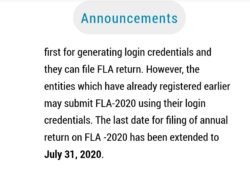
As per the information available on the flair portal of RBI for submission of the foreign asset and liabilities returns for the entities holding foreign investment and liabilities is now been extended to 31st July 2020.

All entities can file a return to the RBI for Foriegn Assets and Liabilities on or before 31st July 2020

FLA Return Due Date Extended to 31st July 2020 2
Screenshot From Flair Portal of RBI

Source FLA Portal

0

Draft Trust Deed for Public Charitable Trust

Trust is created via trust declared by settlor , in the process of declaration of trust settlor is required to execute trust deed , so he can write the terms of creation of trust and anyone in future can act on the basis of trust deed executed by settlor, Trust deed should be drafted vary carefully so as the trust declared by the settlor can achieve its objectives.

Trust Deed is should be duly executed , signed by either settlor or settlor , trustees. To Register Public Trust under Public Trust act of any state Trust Deed is main and important document.

Important clauses in Draft Trust Deed of Public Charitable Trust

Clauses Included in Draft Trust Deed

  • Name of Settlor
  • Declaration of Trust by settlor
  • Object Clause of Trust
  • Declaration as Public Trust
  • Beneficiary Clause
  • Area of Operations
  • Properties of Trust
  • Number of Trustees and There Powers
  • Trust Administration and Power of Board of Trustees
  • Meetings of Board of Trustees
  • Remuneration /Allowances To Trustees & Office Bearers
  • Bank Account
  • Trust Fund
  • Accountability Of Trustees
  • Accounts and Audit of Trust
  • Amendments to Trust Deed
  • Irrevocable Clause
  • Dissolution Clause

Draft Trust Deed

Charitable Public Trust Deed

  • Ready Made Trust Deed Draft Copy in Word
  • Just Change Basic Details like Name , Address, etc or make any changes you want
  • Ready to Print on Stamp Paper
0

Top 3 Marketing Tips for A Startup

Top 3 Marketing Tips for A Startup

You have decided to start your business which you had kept on a burner for a long time. You are very excited and genuinely believe in your product. Having a marketing plan is very important when you are starting a business. Unless you have sales your business will die a slow and painful death.

Top 3 Marketing Tips for A Startup

Don’t worry, you can make sure that you to solve the issue of getting sales by using the 3 marketing tips we have mentioned below to kick start your startup marketing plan. Let’s get started.

1. Set up your website and legal formalities in place

Having a website to showcase your business to the world is one of the most important aspect for a startup. You won’t be able to market your ideas, goods, services, etc to the world without it.

There are many options when it comes to setting up your website. If you have an E-commerce website, Shopify is the best option for you. If you have a services business, WordPress is the best solution for you. If you have a location based website, you can set up a beautiful location based WordPress website.

You need to make sure though that your website is hosted on a robust and stable hosting server. If your business goes viral and you get a lot of visitors to your website, you don’t want your website to just because the hosting wasn’t strong enough. This has happened many times when a business idea went viral. For example, this has happened to businesses that were showcased on Shark Tank.

You can also opt for a local hosting service so that the website is shown to your audience faster. For example, if you are based in Australia, you can find a quality Australian web host to host your website.

Also, make sure that you have set up all the required legal formalities which include setting up your business as an LLC or a Private Limited Company, etc as per your requirements. File all the necessary tax and other declarations, etc. It is best to go with a professional company like us to ensure that there are no compliance issues in the future.

2. Get on social media

Getting your business of product or service viral is very important. You can do so by getting your website or your product viral on social media. Most startups have a very tight budget. To ensure that you make sales fast, social media is the best platform that you can leverage.

It is very easy to sell your products and create awareness for your product on social media platforms. Depending on your product or service, you can focus on various social media platforms.

Instagram and Pinterest are great for home décor, fashion, and retail businesses. LinkedIn is perfect if you want to target other businesses. If your product is visually appealing then you can go for Instagram or YouTube

3. Get Local Press

Using local press to your advantage is an excellent strategy that you can use as a business startup. Most local newspapers and magazines cover a local success story or an upcoming business. You will be able to expand your business and brand awareness with little to no cost. If you are lucky, the article may also be picked up by syndicated news publishers and your product or service can go viral.

Conclusion

Bootstrapping a Startup is difficult but not impossible. With the above three tips, you can easily get started and have sales which will lead to profits. You can use the profits to invest in paid advertising and other avenues which well get more sales and help your business grow.

0

GST Return Late Fee Amnesty Scheme

Amnesty Scheme to provide relief to taxpayers regarding late fee for
pending returns:

Reduced GST Late fee for earlier periods


To provide relief to the taxpayers, late fee for non-furnishing FORM GSTR-
3B for the tax periods from July, 2017 to April, 2021 has been reduced / waived
as under: –
i. late fee capped to a maximum of Rs 500/- (Rs. 250/- each for CGST &
SGST) per return for taxpayers, who did not have any tax liability for
the said tax periods;
ii. late fee capped to a maximum of Rs 1000/- (Rs. 500/- each for CGST &
SGST) per return for other taxpayers;
The reduced rate of late fee would apply if GSTR-3B returns for these tax
periods are furnished between 01.06.2021 to 31.08.2021.

Reduced Late Fee for Future Periods

Rationalization of late fee imposed under section 47 of the CGST Act:
To reduce burden of late fee on smaller taxpayers, the upper cap of late fee is
being rationalized to align late fee with tax liability/ turnover of the taxpayers,
as follows:
A. The late fee for delay in furnishing of FORM GSTR-3B and FORM GSTR-
1 to be capped, per return, as below:
(i) For taxpayers having nil tax liability in GSTR-3B or nil outward
supplies in GSTR-1, the late fee to be capped at Rs 500 (Rs 250 CGST +
Rs 250 SGST)
(ii) For other taxpayers:

For taxpayers having Annual Aggregate Turnover (AATO) in
preceding year upto Rs 1.5 crore, late fee to be capped to a
maximum of Rs 2000 (1000 CGST+1000 SGST);
b. For taxpayers having AATO in preceding year between Rs 1.5
crore to Rs 5 crore, late fee to be capped to a maximum of Rs 5000
(2500 CGST+2500 SGST);
c. For taxpayers having AATO in preceding year above Rs 5 crores,
late fee to be capped to a maximum of Rs 10000 (5000 CGST+5000
SGST).
B. The late fee for delay in furnishing of FORM GSTR-4 by composition
taxpayers to be capped to Rs 500 (Rs 250 CGST + Rs 250 SGST) per return,
if tax liability is nil in the return, and Rs 2000 (Rs 1000 CGST + Rs 1000 SGST)
per return for others.
C. Late fee payable for delayed furnishing of FORM GSTR-7 to be reduced to
Rs.50/- per day (Rs. 25 CGST + Rs 25 SGST) and to be capped to a maximum
of Rs 2000/- (Rs. 1,000 CGST + Rs 1,000 SGST) per return.
All the above proposals to be made applicable for prospective tax periods.

1

How to Apply for 12A and 80G Registration of NGO under Income Tax Act

An NGO ( Society/Section 8 Company/ Trust ) can obtain registration under 12A so that no tax is levied on the Surplus Income of NGO and 80G registration can be obtained so that Donner can claim tax exemption up to 50% of amount donated subject to maximum 10% of Gross Total Income of Donner. 

What is 12A Registration of NGO 

Once NGO has obtained 12A registration, NGO gets Tax Benefits that the Surplus Income of NGO becomes non taxable. 

What is 80G Registration of NGO

An Institution having 80G Registration provides tax benefits to donor up to 50% of donation made to such institution, subject to maximum 10% of Gross Total Income of Donor    

Procedure for Registration under Section 12AA and 80G: 

  • The Application is required to be made in form 10A and 80G
  • The Application is required to filed with Correct Information as regard to Institution , Such as Name , Address and KMP, Date of Incorporation 
  • Details of Author(s)/Founder(s), like PAN , Name , Address 
  • Details of Trustees/Office Bearers/Directors as on the date of filing of application
  • Objects of Institution such as Relief to poor , Medical , Education etc  
  • The Application should be accompanied with
    • Annual Accounts of Last Three Year or Accounts from the Date of Incorporation or Formation Certificate of Incorporation, Registration or Trust Deed Note on Activities of Institution  

Once the Application is Submitted, the Income Tax Department Exemption ward will issue questionnaire asking for some more documents and 
Information: 

Sample Questionnaire : 

1 A declaration that no part of the income of the Trust/ Society/ Non Profit Company enures, directly or indirectly for the benefit of any person specified in section 13(1)(c) of the Income Tax Act, 1961 and that no part of the income or property of the Trust/ Society/Company was ever used or applied for the benefit of any person specified in section 13(1)(c) of the Income Tax Act, 1961, duly signed by the Authorized Signatory.

2 A note specifying the main area of your charitable/ religious activities and a projection/ plan for the main charitable/ religious activities to be undertaken in the next two years.

3 Please attach a ‘No Objection Certificate’ from the owner of the premises from which you are operating along with proof of his ownership.

4 Please attach a certified copy of annual accounts since inception/ during last three years.

5 Please attach a certified copy of the Trust Deed/ Memorandum of Assosiation and produce original copy for verification.

6 Please attach a copy of the proof of identity of the main Trustee/ President or Secretary of the Trust/ Society/ Non Profit Company.

7 Please attach a note on activities conducted since inception/ during last three years.

8 Please attach details of donations made since inception/ during last three years.

9 Please attach details of donations received, including corpus donation, received since inception/ during last three years.

10 Please attach details of your bank accounts including name of the bank, branch, type of account and number of account

11 Please file an undertaking that there will be no infringement to the 1st proviso to section 2(15) of the Income Tax Act, 1961.

12 Please specify the category of charitable purposes provided in section 2(15) of theIncome-Tax Act, 1961 in which your case falls, i.e., whether your objective is relief ofthe poor/ education/ yoga/ medical relief/ preservation of environment (includingwatersheds, forests and wildlife)/ preservation of monuments or places of artistic/historic interest/ advancement of any other object of general public utility/ religiousactivities.

13 Your Trust Deed/ Memorandum of Association does not have Irrevocability Clause.Please include this clause in your Trust Deed/ Memorandum of Association and file acertified copy of the amended Trust Deed/ Memorandum of Association.

14 Your Trust Deed/ Memorandum of Association does not have a clause that thebeneficiaries are a section of the public and not specific individuals. Please includethis clause in your Trust Deed/ Memorandum of Association and file a certified copyof the amended Trust Deed/ Memorandum of Association.

15 Your Trust Deed/ Memorandum of Association does not have any clause providingthat in the event of dissolution of Trust/ Society/ Non Profit Company,the funds/assets of the Trust/ Society/ Non Profit Company will be transferred only to someother Trust/ Society/ Non Profit Company having similar objectives. Please includethis clause in your Trust Deed/ Memorandum of Association and file a certified copyof the amended Trust Deed/ Memorandum of Association.

16 Your Trust Deed/ Memorandum of Association does not have any clause providingthat the funds/ property of the trust will be used only for the objectives of theTrust/Society/ Non Profit Company. Please include this clause in your TrustDeed/Memorandum of Assosiation and file a certified copy of the amended TrustDeed/Memorandum of Assosiation.

17. If the Trust Deed/ MOA etc. are in vernacular language, please furnish certified translatedcopy of entire Trust Deed/ MOA in English/ Hindi.

18. Photocopy of PAN card(s) of the organisation along with the original PAN card forverification.

19. Copies of Income Tax Returns filed for last three years along with computation and AuditReport in Form No. 10B.

20. If represented through authorized representative, duly discharged letter of authorityalongwith name, address, mobile no. and e-mail address may be furnished.

21. Details of charitable or religious activities actually carried out by the organisation since its inception. In case no such activities have been carried out in any of earlier financial years, please furnish such details for the current financial year till date along with the documentary evidence

22. In case of schools/ hospitals, whether necessary the permission from the State Govt./ Local bodies has been obtained? File a copy of same.

23. In the case of any change in trustee/ member/ principal officer/ address of the organisation, copy of relevant change report from Charity Commissioner/ Registrar of Companies may be filed.

24. If any donation from foreign country is received then submit the details of registration under FCRA alongwith donation received and purpose thereof.

25. Please furnish online Acknowledgement receipt of Form No. 10G/ If applied

A hearing is required to be attended for submitting the documents and information as per questionnaire.

Once the CIT, Exemption is satisfied about the Grant of Registration under Section 12A and 80G , he may grant the Registration or call for more such information to the satisfaction of CIT. 

Fastlegal Provides 12A and 80G Registration Services in Rajasthan , Please call 9782280098 or email at support@fastlegal.in

0

How to Register Social Media Marketing Agency Business

How to Register Social Media Marketing Agency Business 3

In this article we will discuss starting social media marketing agency business in India, with the growing popularity of social media and perfect targeting mediums that provided by the social media websites, social media marketing agency business is now gaining popularity has the traditional form of advertising means are costly and provides the less conversation, what are the hand if you are doing a social media marketing with the very minimum cost you can start getting the actual customers that you need.

Social media marketing spending amounts to increasing the main requirement of the agencies who can handle the social marketing agency business for the clients.

social media marketing agency

Following steps are involved for starting social media marketing agency business

1. Learning the social media marketing:

If you’re starting the social media marketing business you need to know

how the social media marketing works, what are the steps involved, how you can acquire more targeted customers to your clients need,

To learn everything that social media marketing provides this will take time to get expert knowledge in the social media marketing but the first step involved is to get the learning how it works, there a penalty of online courses available or you can get it out by doing it yourself with experimenting the Facebook ads, Google ads, etc.

2. Setting up of website and social media accounts for your social media marketing agency

once you get some understanding about how the social media marketing works to start out by setting up you on the website and social media pages

3. Getting the first client

Getting the first client for the social media marketing business is not an easy task, to get the first client you need to do some promotional activities, the best thing that you can do is to offer a free service for first clients for a period of initial months this will help the client to have faith on you and once you prove the results, you will be getting a testimonial for your next clients

4. Getting your agency registered as a private limited company

Once you start out the actual business operations you can go for starting out your own private limited company and get all the activities of your agency get done through the bank account of the private limited company, you should raise all the invoices in the name of your company and accept payments in the bank account of the company.

You can get the payment gateway integration with your company bank account on accept payments via payment gateways

5. Maintaining the Regular Compliances for your Company

As you register your business as a private limited company you need to do certain compliance as per the government regulations, it is very much mandatory to do them all the government compliance is on time to get your business running smoothly, you can take help of consultants to manage your compliance very easily, please note that known maintaining the legal compliances can make you in trouble as there are very high penalties for non-compliances.

Fastlegal provides business registration and legal compliance Management services to all type of businesses, if you need any help you can directly email at mail@fastlegal.in or call us at 9782280098


How to Play Teen Patti and Other Games You May Not Have Known About

Many countries have devised their version of different games, some are original while others are based on an existing game, and upgraded. One of these is the popular South Asian game known as ‘Teen Patti’, which is also known as ‘three cards’ in English.

Steps Involved in Playing Teen Patti

As mentioned above this is a popular game in South Asia, and is a gambling game that many enjoy. It is played with a normal deck of 52 cards, not including the Joker. It is typically played with real money and can be played by up to 6 players and no less than 3 players.

Played with either no limit or pot limit, this game is similar to the game of Poker or Texas Hold ‘em, the goal of each player is to maximize the value of their individual pots and to win by either having the best three cards or laying down your hands.   

First, you select a dealer: once you draw cards, the dealer is selected and the person with the highest drawn cards gets to play that position. However, don’t be dismayed as everyone gets a turn to be a dealer. This will go clockwise and, in every round, a dealer is chosen.

Then you place an ante: an ante is collected for each of the players, this is to form an initial pot which the players will compete for. The pot is usually capped at equaling 1024 times when played with a limit, however, you can also play without a limit. This game does not necessarily need to be played in the physical but can also be played online, and when playing online, you can place the ante via a 3 Patti real money paytm cash deposit, and each player will deposit their amount.

Once this is done, then you get your cards: the dealer will hand out the cards to each player. He deals three cards facing down to himself and then to each player in a clockwise direction.

The acting starts: Now that the game has started, the first player on the left-hand side goes, and he can choose to play a blind card, without seeing his cards, or if decided at the beginning of the game with his cards seen. If he plays without seeing the cards, he can do three things, either he can choose to fold, raise to double the pot or call the ante. If he chooses to play with his cards seen, he can double the ante, fold or raise to quadruple it. The bet he makes is known as the ‘stake’.

It’s the next player’s turn: when it’s the turn of the next player, the acting continues. Each of the players will have an option to fold, raise or call either through cards seen or hidden (blind). Depending on the stake the previous player has placed, the next player can bet on it and set a newer stake. If he chooses to place a blind it can be either x1 or x2 the stake amount if it is blind, however, if it is a seen card then he can place a bet of x2 or x4 the stake. The new stake is always either always half as much as the existing one. 

A side-show: when there are at least three players left in the game, and after two of the consecutive ‘seen players’ play their turn, then they can request a side-show with the previous player. If you are that player you can either deny or accept the request. In the event the player accepts the request he will secretly show his cards to the other opponent and the one with the worst hand ranking will be eliminated and the game will continue.

Teen Patti Hand Rankings  

From the best hand to the worse hand the below are the hand rankings for Teen Patti:

  • Best hand: Set / Trail / Trio. Three like cards irrespective of suit or colour (for example 9-9-9 of diamonds or A-A-A heart and spade)
  • Second best hand: Straight Flush or Pure Sequence. Three successive cards of the same suit and colour (for instance, K-Q-J of clubs or A-2-3 of hearts)
  • Third best hand: Run / Sequence / Straight. Three consecutive cards of unlike suits (for instance, A-2-3 or K-Q-J of a spade, heart, and diamond)
  • Fourth best hand: Flush / Color. Three cards of the same colour and suit, but not in a sequence (for instance, 9-4-3 of spades or A-K-K of hearts)
  • Fifth best hand: A Pair. Two cards of the same rank regardless of colour or suit (for instance A-A-9 or 5-5-J)
  • Worst hand: High Card. Three cards that are not in a sequence, of the same value or the same suit (for instance, A-9-4 with two diamonds and one spade)

Hopefully, you get the gist of the game, and if it’s too complicated to play using real cards, there is always the option of playing online!

Below are some of the other games that originated from their own countries that you may never have heard of:

United Kingdom – Pass the Parcel

Starting with games in the United Kingdom, one that’s a popular and traditional game is “Pass the Parcel”. Involving music and merriment alongside some crumpets and tea. This is a game that requires some preparation and is worth every effort. The basic idea is someone places a prize inside a box and wraps it up strategically, so no one can tell what’s inside.

The parcel is passed around a circle and once the music stops you remove one layer of the wrapping, and the music continues, till the person who removes the last layer of wrapping paper gets the prize! Pretty simple, ey? But so much fun, the anticipation keeps everyone going. Did we mention the DJ or person in charge of the music is blindfolded?

Brazil – Luta De Galo

“Luta De Galo” is a game that originated from Brazil, in Portuguese, it means “Fight of The Roosters”. If you are into an adventurous and funny game, this would be it. Ever wanted to act like a chicken? This is a hilarious game that doesn’t involve any fighting, funny enough. However, you will need props that include a rag, a bandana, a small towel, and a handkerchief to play with.

Nigeria – Ten Ten

The wildly popular game Ten Ten is a popular one in Nigeria and is a clapping game that’s so nice, they named it twice. Similar to the game we all have played at least once in our lifetimes, “Rock Paper Scissors”, the only difference is it is played with your feet, with some added singing and clapping. It sure helps with enhancing your hand-eye coordination, to get you into the rhythm of things.

0

No OSP Registration Requirement for Running BPO/Call Centres as per New OSP Guidelines

Department of Telecommunications has issued new OSP guidelines for Other Services Provide (OSP) where Registration for Other Service Providers (OSP) requirements has now done away with, you can just register your Private Limited Company/LLP or Partnership Firm or Obtain Shop and Establishment Registration and can start your own Call Centre, Also, as per the guidelines OSP has to take care that there should not be any Toll Bypass and Recordings and Call Logs to be maintained for period of 1 years .

The New OSP Guidelines have been issued on 23rd of June, 2021 by Department of Telecommunication for ease in Business of Running Call Centres and BPO’s across India

New Guidelines

  • No Registration Requirements with DOT
  • NO Static IP Requirement for Work From Home
  • No Security Deposit for Work From Home
  • Bank Guarantee Not Required
  • All Types of Business Entities Private Limited/LLP/Partnership/Proprietorship permitted
  • Exemption to Non Voice Based OSP
  • Voice Traffic Flow allowed between Domestic and International OSP

Old Guidelines

  • Mandatory Registration Requirement
  • Static IP Requirement for Work From Home
  • Security Deposit Required for Work from Home
  • Bank Guarantee required
  • Only Private Limited and LLP were permitted
  • Non Voice Based OSP were Covered
  • Voice Traffic Flow not Allowed

Chapter –  1 Definitions

The terms used in this document, unless the context otherwise requires, have ‹he following meaning”.

  • “Authority’  means Department  of Telecommunications or its designated  field  wits (Licensed Service Areas or LSAs).
  • ‘Company’ means an Indian Company, registered under the Indian Companies  Act, 2013 or a Partnership Firm or an organization registered under Shops and Estat3lishments Act.
  • ‘LLP’ means a Firm incorporated and registered under Limited Liability Partnership Act- 2008 in India.
  • No OSP Registration Requirement for Running BPO/Call Centres as per New OSP Guidelines 4Other Service Provider’ (OSP) is an Indian company, registered under the Indian Companies Act, 2013 or an LLP (Limited Liability Partnership) registered under LLP Act, 2008 or a partnership firm or an organization registered under Shops  and Establishment  Act providing voice based Business Process Outsourcing (BPO) services to their customers located worlci-wide including in India.
  • No OSP Registration Requirement for Running BPO/Call Centres as per New OSP Guidelines 5‘Voice based BFO services’ means call centre services provided  by the OSPs wherein the customers access the network of the OSP through PSTN/PLMN/ISDN.
  • No OSP Registration Requirement for Running BPO/Call Centres as per New OSP Guidelines 5‘OSP Centre’ means the infrastructure of an OSP at a location in India.
  • No OSP Registration Requirement for Running BPO/Call Centres as per New OSP Guidelines 5‘Point of Presence’ (POP) is a location where OSP places equipment like Private Automatic Branch Exchange (PABX), Interactive Voice Recording System {IVRS) etc., to act as an extension of OSP Centre for Collecting information, converting, carrying and exchanging the telecom traffic related to its services.
  • No OSP Registration Requirement for Running BPO/Call Centres as per New OSP Guidelines 5‘Telecom Service Provider’ (TSP)/ Telecom Licensee means an entity who has been granted a valid licence under Section-4 of the Indian Telegraph Act, 1885 to provide Telecom Service as per the License in a Licensed Service Area (LSA).
  • ’Telecom Resource’ means Telecom facilities provided by TSFs and used by the OSPs including, but not limited to Public Switched Telecom Network (PSTN), Public Land Mobile Network {PLMN), Integrated Services Digital Network (ISDN), Leased Lines (NPLC/ IPLC), MPLS VPN, internet leased lines, Broadband connectivity {wireline/ wireless), BRA/PRi lines to carry traffic.
  • Toll Bypass: Toll bypass for the present guideline shall mean illegal carriage of voice traffic infringing upon the jurisdiction of authorised TSPs in the following ways:
    • Voice calls between public network (PSTN/ PLMN/ ISDN) in India and Foreign country by transiting it through their own network,
    • Voice calls between public network (PSTN/ PLMN/ ISDN) of one city and the other city in India by transiting it through their own network.
OSP Guidelines
OSP Guidelines

Chapter – 2    General Guidelines for OSPs

  1. Registration: The distinction between international OSPs and domestic OSPs has been removed and no registration will be required for OSP centres in India.
  2. Bank Guarantee: No Bank Guarantee whatsoever will be required for any facility or dispensation under these Guidelines.
  3. Special Dispensations for OSP:
    • For the OSPs the collection, conversion, carriage and exchange of the incoming PSTN/PLMN/ISDfiI traffic is permissible over any wide area networking technology like MPLS VPN/NPLC or SD-WAN over NPLC/MFLS VPN interconnecting the different OSP Centres.
    • The OSPs ale allowed to carry the aggregated switched voice traffic (incoming/ outgoing) between their POP and their OSP centre in India over any wide area networking technology like IPLC/NPLC/MPLS VPN or SD-WAN (over IPLC/NPLC/MPLS VPN) and transiting it betwee.n other OSP centres in India over NPLC/MPLS  VPN or SD-WAN (over NPLC/ NtPLS VPN).
    • lnterconnectivity of voice calls between two or more OSP Centres of the same Company or group of companies or unrelated companies is permitted for OSP operations.
    • Interconnection of Remote Agent to the OSP centre is permitted using any technology including broadband over wireline/wireless.
    • An OSP having multipIe centres may obtain internet connection from authorised TSP at a centralised location anywhere in India. Fhis internet can be accessed from other OSP centres of the same company or Group companies Using NPLC/ MPLS VPN or SD-WAN (over NPLC/MPLS vPNj.
    • Entities that are not carrying out voice-based business process outsourcing services shall not be regulated under the OSP Guidelines.
  4. Inspection and reports: The OSPs have to self-regulate their operations in such a manner that there is no toll bypass and infringement on the jurisdiction of authorized TSPs. There is no requirement to submit any report/ information to the DOT HQ or its field units on normal routine basis. However, the OSPs have to maintain Call Data record (CDR), Usage Data Record (UDR) and System *OSS for alt customer calls for the required period as mentioned in Chapter-5 ”Security Conditions” and submit it to LEAs/ DOT, if requested. No audit/inspection on routine basis of the OSP centres shall be carried out by DoT

Chapter -3:     Guidelines for sharing infrastructure, Use of Distributed Architecture of EPABX and Interconnection

  • Sharing the Infrastructure: Sharing the infrastructure including EPABX and PSTN/PLMN lines of OSP Centres for office use is permitted.
  • Foreign EPABX: EPABX at foreign location is allowed for the OSPs, However, the OSP will take all the necessary measures to comply with the requirements of relevant provisions of Indian laws. In addition, the OSP shall maintain a copy of CDR/ UDR and System logs at any of its OSP centres in India.
  • Use of distributed architecture of EPABX for OSP centres across India:
    • OSPs can have a distributed architecture of EPABX (main EPABX at a centralized location and media gateways at Individual OSP Centres) for their OSP centres Across India ,where the EPABX owned by OSP OSPs may place their self owned EPABX in 3rd party data centres in India . OSPs can also take EPABX services from the TSPs.
  • OSP centres which do not make outgoing calls to the PSTN/PLMN in India may atso use a centralised media gateway.

4.    Interconnection:

Chapter-4         Work-From-Home (WFH)/ Work-From-Anywhere (WFA)

The concept of Work-From-Home is being encouraged under these guidelines and has been extended to allow work From-Anywhere in India. This facility of Remote Agent Position (i,e. Work-From- Home/Anywhere) is permitted with the following conditions:

  1. The agents at home/ anywhere in India shaIl be treated as Remote Agents of the OSP Centre.
  • Interconnection of remote agents to the OSP centre is permitted using any technology including broadband over wireline /wireIess,
  • The remote agent of an OSP centre may connect directly with the centralised EPABX/ EPABX of the OSP/ EPABX of the customer.
  • The OSP shall be responsible for any violation related to toll-bypass.

Chapter -5 Security Conditions

The OSP shall not engage in the provision of any Telecom Services.

  • For EPABX installed at locations different than the OSP Centre, the remote access of aid CDRs, System log, configurations of I PABX and touting tables shall be made available on demand from Authority/ Law Enforcing Agencies from at least one of the OSP centres.
  • OSP will take all the necessary measures to comply with the requirements of relevant provisions of Indian laws.
  • On specific instances of infringements such as carriage of objectionable, obscene, unauthorized messages or communications infringing copyright, intellectual property etc. in any form on their networks, the OSP shall ensure that the carriage of such material on the networks is prevented immediately.
  • The OSP shall extend support to the Authority in tracing any nuisance, obnoxious or malicious calls, messages or communications transported through its equipment and network.
  • OSPs shall be required to preserve the CDRs for all the voice traffic carried using the EPABX. OSP shall maintain a copy of CDR and System logs at any of its OSP centres in India, The CDRs shall be segregated for each OSP centre/ media gateway. It shall be possible to view the CDR data along with details of the agent manning the position by remote login to CDR machine/ server. The time-stamp in the CDRs in the system(s) of the OSP shall be synchronized with the Indian Standard Time.
  • The CDR/ UDR/ system logs etc. should Contain all relevant information which is essential for the LEAs for tracking/forensic purpose. The CDR/ UDR shall consist of Calling Number, Calted Number, Date, Start Time, End time/ duration, Identity of the Device used for making the call (MAC ID, Device signature etc.), User identity {login name) initiating the session, MGW identity/ Soft-switch ID and Trunk ID etc, System log shall consist of User/ login identity, date & time of login, date & time of logout, commands/ activities performed, response of command/ activities.
  • For Remote Agents, the OSP shall ensure that the system logs are tamper-proof and the CDRs/ all logs of the activities carried ot3t by the Remote Agent shall be maintained for one year.
  • In all the above cases, CDRs / UDRs / System logs, etc. shall be maintained for a period of one year,

For Company /LLP Registration for Running your Own BPO/Call Centre, Please Submit your request below

0

Compliance Due Dates for Mandatory Filings in the Month of October 2019

  • 7th October – Payment of TDS for the Month of September 2019
  • 11th October- GSTR1 – Monthly
  • 14th October – Director KYC (DIR3KYC)
  • 14th October- Auditor Appointment, if AGM held on 30th September and Auditor appointment is applicable
  • 15th October- Payment of ESIC and PF Chalan
  • 20th October- GSTR3B
  • 28th October- AOC4 for Companies , if AGM held on 30th September 2019
  • 30th October- LLP Form 8 ( for LLP)
  • 30th October- MSME form for Reporting of dues to MSME Enterprises
  • 30th October- Tax Audit
0

A Comprehensive Guide to Choosing Good Companies for Investment in India

Investing in the stock market can be a rewarding venture, but it requires careful consideration and research. For those looking to invest in India, a country with a burgeoning economy and a wealth of opportunities, making well-informed choices is crucial. In this blog post, we will explore ten essential steps to identify good companies worthy of investment in the Indian market.

1. Research, Research, Research!

Before you start investing your hard-earned money, delve into the world of research. This step cannot be stressed enough. Look beyond the surface and dive deep into the company’s background, financial reports, and market reputation. Websites like the National Stock Exchange of India (NSE) and Bombay Stock Exchange (BSE) can serve as valuable resources.

2. Analyze Financial Health

A company’s financial health serves as a barometer for its stability and potential growth. Study its balance sheets, income statements, and cash flow statements to assess its profitability, liquidity, and solvency ratios. Steer clear of companies with excessive debt burdens or inconsistent revenue streams.

3. Management Team Evaluation

A company’s leadership plays a pivotal role in its success. Scrutinize the management team’s experience, vision, and track record. Look for companies led by competent individuals who have successfully navigated challenges and have a reputation for transparent and ethical practices.

4. Uniqueness and Competitive Advantage

Seek companies that possess a unique selling proposition or a strong competitive advantage. Whether it’s proprietary technology, an innovative product, or a strong brand identity, a competitive edge can drive sustained growth and profitability.

5. Growth Prospects

Assess a company’s potential for growth in its industry and market. Look for businesses with expansion plans, a widening customer base, or strategic partnerships. Companies with promising growth prospects are more likely to yield higher returns over time.

6. Dividends and Earnings History

Stability in dividends and consistent growth in earnings are indicators of a company’s financial strength. Dividends are a share of the profits distributed to shareholders, making dividend-paying companies an attractive option for investors seeking regular income.

7. Analyze Industry Outlook

Understand the dynamics of the industry in which the company operates. Consider factors such as market trends, competition, regulatory environment, and potential risks. Invest in industries with favorable outlooks for sustainable long-term growth.

8. Valuation Comparisons

Compare the company’s valuation metrics, such as price-to-earnings ratio (P/E), price-to-book ratio (P/B), and dividend yield, with its peers and historical averages. A company with a reasonable valuation relative to its growth potential might make for a prudent investment.

9. Diversification for Risk Management

Diversification is a fundamental strategy to mitigate risk. Spread your investments across different sectors and industries, as this can reduce the impact of volatility in any particular market segment.

10. Embrace a Long-Term Perspective

Investing in the stock market requires patience and a long-term perspective. Avoid getting swayed by short-term fluctuations and focus on the company’s fundamentals and long-term growth potential.

Conclusion

Choosing good companies for investment in India necessitates a methodical approach. By conducting in-depth research, analyzing financials, assessing management, and understanding industry dynamics, you can identify companies with promising growth prospects and solid fundamentals. Diversify your investments, embrace a long-term mindset, and always seek guidance from financial advisors to make informed and confident investment decisions. Remember, the key to successful investing lies in informed choices and a commitment to staying updated with market trends. Happy investing!