support@fastlegal.co.in
 +91-9782280098
Understanding Section 54EC Bonds and Alternatives for Tax-Saving on Long-Term Capital Gains
The issuance of capital gain bonds under Section 54EC of the Income Tax Act, 1961, by government-backed entities like the Power Finance Corporation (PFC), Rural Electrification Corporation (REC), and Indian Railway Finance Corporation (IRFC) provides a tax-efficient way for investors to save on long-term capital gains (LTCG) while supporting infrastructure development. This blog post explores how Section 54EC bonds work, their applicability to securities, the tax implications of selling these bonds after the lock-in period, and other alternatives for saving tax on LTCG. Whether you’re an investor selling securities, property, or other assets, this guide will help you navigate your tax-saving options.
What Are Section 54EC Capital Gain Bonds?
Section 54EC bonds are tax-exempt instruments issued by government-backed entities such as PFC, REC, and IRFC. They allow taxpayers to exempt LTCG from tax by reinvesting the gains within 6 months of selling a long-term capital asset. Here’s how they work:
- Tax Exemption: Up to ₹50 lakh of LTCG per financial year can be invested in 54EC bonds to claim exemption from LTCG tax, currently 12.5% (without indexation for real estate and most securities, as per the 2024 Union Budget).
- Eligible Assets: The exemption applies to LTCG from the sale of long-term capital assets, such as:
- Immovable property (land or building) held for more than 24 months.
- Securities (listed shares or mutual funds held for >12 months, unlisted shares held for >24 months).
- Other assets like jewelry or bonds, if held for the required period.
- Investment Timeline: The LTCG must be invested within 6 months from the date of sale.
- Lock-in Period: The bonds have a 5-year lock-in, during which they cannot be sold, transferred, or used as collateral. If sold before 5 years, the exempted LTCG becomes taxable as LTCG in the year of sale.
- Interest Rate: The bonds offer a fixed interest rate of around 5–5.25% per annum, payable annually. The interest is taxable under “Income from Other Sources” as per the investor’s tax slab, with no Tax Deducted at Source (TDS).
- Safety: These bonds are AAA-rated and government-backed, ensuring low credit risk.
- Investment Process: Purchase bonds via the issuer’s website (e.g., PFC, REC, or IRFC), designated branches, or platforms like IndiaBonds. Submit KYC documents (PAN, address proof) and payment. Bonds can be held in demat or physical form.
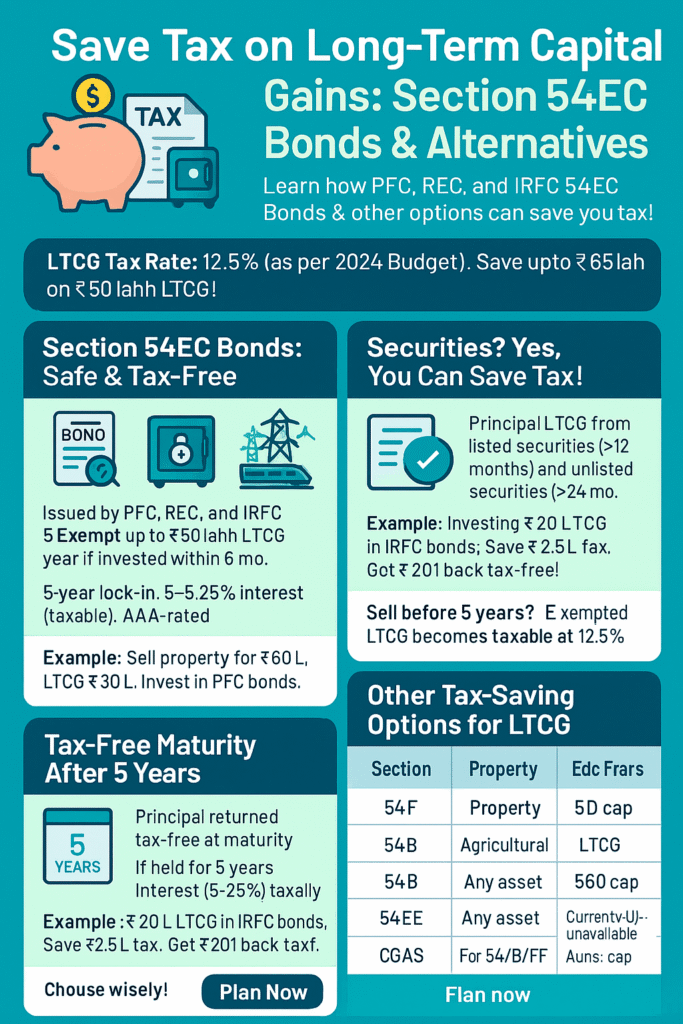
Example of Section 54EC Bonds
Suppose you sell a residential property in 2025 for ₹80 lakh (indexed cost: ₹50 lakh), resulting in an LTCG of ₹30 lakh. By investing ₹30 lakh in PFC’s 54EC bonds within 6 months:
- The entire ₹30 lakh LTCG is exempt, saving ₹3.75 lakh tax (12.5% rate).
- You earn 5.25% interest annually (₹1.575 lakh/year), taxable as per your slab.
- After 5 years, the ₹30 lakh principal is returned tax-free.
If you invest only ₹20 lakh, ₹20 lakh is exempt (saving ₹2.5 lakh tax), and the remaining ₹10 lakh is taxable (₹1.25 lakh tax).
Role of PFC, REC, and IRFC in Infrastructure Financing
PFC, REC, and IRFC are key players in India’s infrastructure financing:
- Power Finance Corporation (PFC): Finances power sector projects, supporting electricity generation, transmission, and distribution.
- Rural Electrification Corporation (REC): Focuses on rural electrification and power infrastructure development.
- Indian Railway Finance Corporation (IRFC): Funds railway infrastructure, including rolling stock and network expansion.
By issuing 54EC bonds, these entities raise low-cost capital for infrastructure projects while offering investors a safe, tax-saving investment. The bonds’ tax-exempt status attracts investors, reducing borrowing costs for these companies and supporting India’s infrastructure goals.
Are the Proceeds from Selling 54EC Bonds After 5 Years Exempt?
Yes, if you hold Section 54EC bonds (e.g., PFC, REC, or IRFC bonds) for the full 5-year lock-in period and redeem them at maturity, the principal amount is not taxable. Here’s why:
- Principal Repayment: The amount returned at maturity is the original investment (e.g., ₹30 lakh in the above example), considered a return of capital, not a capital gain.
- Original LTCG Exemption: The LTCG exempted by investing in the bonds (e.g., ₹30 lakh) remains exempt as long as the bonds are held for 5 years.
- Interest Taxation: The annual interest (5–5.25%) is taxable each year under your income tax slab, but this does not affect the principal’s tax-free status.
Example
You sell a property, realize ₹20 lakh LTCG, and invest it in REC 54EC bonds. The ₹20 lakh is exempt (saving ₹2.5 lakh tax). You earn ₹1.05 lakh interest annually (taxable). After 5 years, the ₹20 lakh principal is returned tax-free, and the original LTCG exemption is secure. However, if you sell the bonds before 5 years, the exempted LTCG becomes taxable at 12.5% in the year of sale.
Do Section 54EC Bonds Apply to Securities?
Yes, Section 54EC bonds are applicable to LTCG from the sale of securities, provided they qualify as long-term capital assets:
- Listed securities (equity shares, listed bonds, mutual funds): Held for >12 months.
- Unlisted securities (e.g., unlisted shares): Held for >24 months.
Example for Securities
Sell listed equity shares (held >12 months) for ₹60 lakh (cost: ₹40 lakh), LTCG = ₹20 lakh. Tax without exemption = ₹2.5 lakh (12.5% rate). Invest ₹20 lakh in PFC 54EC bonds:
- Entire ₹20 lakh LTCG is exempt, saving ₹2.5 lakh tax.
- Earn 5.25% interest (₹1.05 lakh/year), taxable.
- After 5 years, ₹20 lakh principal is returned tax-free.
If you invest only ₹10 lakh, ₹10 lakh is exempt (saving ₹1.25 lakh tax), and the remaining ₹10 lakh is taxable (₹1.25 lakh tax).
Considerations
- Tax Rates: LTCG on equity shares/mutual funds is taxed at 12.5% (above ₹1.25 lakh/year); other securities (e.g., debt funds, unlisted shares) at 12.5% without indexation.
- Low Returns: The 5–5.25% interest rate is lower than alternatives like fixed deposits (5–7%) or equity markets.
- Liquidity: The 5-year lock-in reduces flexibility compared to other investments.
Alternatives to Section 54EC Bonds for Tax-Saving on LTCG
If you’re looking to save tax on LTCG from securities or other assets, here are the key alternatives under the Income Tax Act:
1. Section 54: Residential Property Sales
- Applicability: For individuals/HUFs selling a residential property (held >24 months).
- Investment: Invest LTCG in 1–2 residential houses in India:
- Purchase: Within 1 year before or 2 years after sale.
- Construction: Within 3 years from sale.
- Exemption: Full LTCG exempt if fully invested; proportional if partially invested. Capped at ₹10 crore (post-July 23, 2024).
- Lock-in: New property must be held for 3 years.
- Capital Gains Account Scheme (CGAS): Deposit unutilized LTCG in CGAS before ITR filing if not invested immediately.
- Relevance to Securities: Not applicable (only for residential property).
- Pros: High exemption (up to ₹10 crore), potential property appreciation.
- Cons: High investment cost, 3-year lock-in.
2. Section 54F: Any Long-Term Asset (Including Securities)
- Applicability: For individuals/HUFs selling any long-term asset (e.g., securities, non-residential property) except a residential house.
- Investment: Invest entire sale proceeds (not just LTCG) in 1 residential house:
- Purchase: 1 year before or 2 years after sale.
- Construction: 3 years from sale.
- Exemption: Full LTCG exempt if entire proceeds invested; proportional if partial (Exemption = LTCG × Amount Invested / Sale Proceeds). Capped at ₹10 crore.
- Conditions: Must not own more than 1 residential house (other than the new one) on sale date. New house has a 3-year lock-in.
- CGAS: Deposit unutilized proceeds in CGAS before ITR filing.
- Example: Sell shares for ₹60 lakh (LTCG: ₹20 lakh). Invest ₹60 lakh in a house. Entire ₹20 lakh is exempt. If you invest ₹30 lakh, exemption = ₹20 lakh × (30/60) = ₹10 lakh; remaining ₹10 lakh taxable.
- Pros: High exemption, applicable to securities, potential property appreciation.
- Cons: Full proceeds investment, 1-house rule, high cost.
3. Section 54B: Agricultural Land
- Applicability: For individuals/HUFs selling agricultural land (used for agriculture for ≥2 years, held >24 months).
- Investment: Invest LTCG in another agricultural land within 2 years.
- Exemption: Full LTCG exempt if fully invested; proportional if partial.
- Lock-in: New land held for 3 years.
- CGAS: Deposit unutilized LTCG in CGAS.
- Relevance to Securities: Not applicable.
- Pros: Supports agriculture.
- Cons: Niche, not for securities.
4. Section 54EE: Specified Units (Currently Unavailable)
- Applicability: For any taxpayer selling any long-term asset (including securities).
- Investment: Invest LTCG in notified fund units (e.g., for start-ups).
- Exemption: Up to ₹50 lakh/year, 3-year lock-in.
- Status: Currently unavailable (no notified funds).
- Relevance to Securities: Would apply if activated.
- Pros: Shorter lock-in (if available).
- Cons: Not an option as of July 2025.
5. Capital Gains Account Scheme (CGAS)
- Applicability: For Sections 54, 54B, 54F if investment isn’t made before ITR filing.
- How It Works: Deposit unutilized LTCG/proceeds in CGAS at a bank (e.g., SBI). Use within 2–3 years as per the section’s rules, or unutilized amount becomes taxable.
- Relevance to Securities: Applies for 54F.
- Pros: Temporary flexibility.
- Cons: Low returns, administrative effort.
Comparison Table
| Option | Eligible Asset | Investment | Exemption Limit | Lock-in | Securities Applicable | Pros | Cons |
|---|---|---|---|---|---|---|---|
| 54EC Bonds | Any long-term asset | LTCG in bonds | ₹50 lakh/year | 5 years | Yes | Safe, fixed returns | Low interest, long lock-in |
| Section 54 | Residential property | LTCG in 1–2 houses | ₹10 crore | 3 years | No | High exemption, appreciation | Property-specific, high cost |
| Section 54F | Any asset except house | Full proceeds in 1 house | ₹10 crore | 3 years | Yes | High exemption, appreciation | Full proceeds, 1-house rule |
| Section 54B | Agricultural land | LTCG in agricultural land | No cap | 3 years | No | Supports agriculture | Niche, not for securities |
| Section 54EE | Any long-term asset | LTCG in units | ₹50 lakh/year | 3 years | Yes (if available) | Shorter lock-in | Unavailable |
| CGAS | For 54, 54B, 54F | Deposit in CGAS | As per section | Until used | Yes (for 54F) | Flexibility | Low returns, admin burden |
Strategic Considerations for Investors
- Tax Rates: LTCG on equity shares/mutual funds is 12.5% (above ₹1.25 lakh/year); other securities and real estate at 12.5% without indexation. Compare tax savings vs. investment returns.
- Risk vs. Return: 54EC bonds (PFC, REC, IRFC) are safe but yield low returns (5–5.25%). Real estate (54F) offers appreciation but involves market risk and high costs.
- Liquidity: 54EC has a 5-year lock-in; 54F has a 3-year lock-in but requires larger investment. CGAS provides temporary flexibility.
- Financial Goals: Choose based on tax liability, investment size, and whether you prioritize safety (54EC) or asset growth (54F).
Why Choose PFC, REC, or IRFC 54EC Bonds?
Section 54EC bonds from PFC, REC, and IRFC are attractive for:
- Tax Savings: Exempt up to ₹50 lakh LTCG, saving significant tax (e.g., ₹6.25 lakh on ₹50 lakh at 12.5%).
- Safety: AAA-rated, government-backed.
- Infrastructure Impact: Supports critical sectors like power and railways.
However, the 5-year lock-in and low interest rate require weighing against alternatives like 54F for larger exemptions or other investments for higher returns.
Conclusion
Section 54EC bonds issued by PFC, REC, and IRFC offer a secure, tax-saving option for LTCG from securities, property, or other assets. Holding these bonds for 5 years ensures the principal is returned tax-free, with the original LTCG exemption intact. For securities, Section 54F provides an alternative for larger exemptions (up to ₹10 crore) by investing sale proceeds in a residential house, while CGAS offers temporary flexibility. Evaluate your options based on tax liability, investment goals, and liquidity needs to make an informed decision.
For personalized advice or calculations based on your LTCG, consult a tax professional or share specific details (e.g., asset type, gain amount) for tailored guidance. Stay informed and save smart!
Place Your Request